

Why Integrity Feels Like a Liability in Schools (The Frank Grimes Effect)
Meritocracy, Myth, and the Teacher Who Snaps

Last time, I gave some thoughts about what teachers are supposed to do or be in the face of encroaching authoritarianism. It got me thinking more about what I’m doing and how I’m doing it1. Reflection is good for the soul.
The thing is, a couple of times a year, I go insane at work. My close friends and my wife know this, and a few months back, I was able to put a name to it. A specific name: Frank Grimes.

Who is Frank Grimes?
The Simpsons, season 8, episode 23 - “Homer’s Enemy.”
If that doesn’t ring bells, Frank Grimes2 (“Grimey”) was the guy who dedicated his entire life to hard work, grit, and excellence…only to be devoured by a system that rewards mediocrity, vibes, and whoever “seems nice.”
He cares too much in a universe that cares too little. He’s the person who expects logic in a system explicitly built without it.
He is, in short, a teacher in 2025.
Frank Grimes is the patron saint of educator burnout3.
The quick version of the episode, if it’s been a minute - Frank Grimes is the hardest-working man in Springfield — a self-made striver who survived every hardship imaginable.
Grimes tries to fix the system, follow the rules, and hold people accountable. And then he meets Homer. The system responds by punishing him, rewarding Homer, and giving the Executive Vice-President job to a dog4. No, seriously.
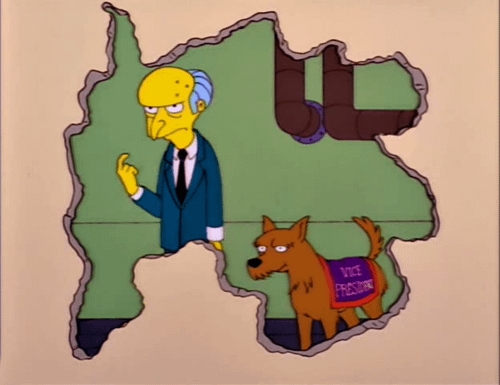
Grimes ends up electrocuting himself while angrily imitating Homer’s behavior.
At his funeral, Homer falls asleep, sleep-talks to Marge, everyone laughs, aaaaand scene.
No, Seriously, Who is Frank Grimes?
Okay - I’m turning on my institutional organization and behavior fanboy for this. I probably read and listen to too much Adam Grant, but…
Sometimes it’s the veteran who’s held the building together with grit and binder clips since 1998. Sometimes it’s the rookie who still thinks the PD slides contain some secret, universal truth. Sometimes — and this is the uncomfortable part — Frank Grimes is you.
Or me.
Grimes named it. He said what we all know and see out loud.
Why Frank Grimes Still Snaps
Frank Grimes isn’t just a character; he’s a diagnostic tool. He’s what happens when a high-integrity person walks into an ecosystem built around something entirely different.
Grimes assumed the workplace was a meritocracy — that competence earns influence, that effort earns respect, that consistency counts for something.

Institutions reward the people who smooth the waters, not the ones who clarify them.
They admire competence right up until it asks inconvenient questions.
They love integrity until it creates friction.
Once that misalignment clicks into place — your integrity versus the institution’s appetite for convenience — the slide into Grimes Mode begins.
Not with anger.
Not with ego.
With expectation.
The Problem Isn’t Integrity — It’s What Institutions Do With It
Before anyone warms up their vocal cords to say, “Oh, so you think you have integrity? Maybe you’re just an asshole5,” let’s establish something:
I’m not nominating myself for sainthood here. I’m not the Patron Saint of Principled Behavior. Most days, I’m just trying to keep my standards, my patience, and my coffee at reasonable levels.
This isn’t about me being morally superior. It’s about what happens when anyone tries to bring integrity into a system that prioritizes convenience.
Because here’s the uncomfortable truth:
Institutions don’t bless integrity. They tolerate it until it becomes an inconvenience.
Integrity is admirable until it requires someone else to change.
And this is exactly what Frank Grimes discovers, painfully and in real time.
He believes the system should care.
But institutions — schools very much included — run on a different fuel entirely:
Compatibility over competence.
Compliance over clarity.
Truth bent toward comfort.
The people who succeed long-term are not the best at the job; they’re the best at not threatening anyone else’s sense of stability.
Grimes violated the unspoken rule: he expected meritocracy in a system designed for equilibrium.
He assumed institutions reward excellence. They don’t.

They reward people who don’t rock the boat. They reward the easy colleague, the pleasant presence, the person who nods at PD slides with a very audible, “Mmm-hmmm,” even when the math is wrong.
And this is where the descent into Grimes-hood begins — with misaligned expectations.
Because once you think your competence should matter, and once you realize the system isn’t interested in that…the spiral starts:
You notice things.
You point them out.
You assume someone will appreciate that you noticed.
The institution grows uneasy.
You double down, because this is supposed to matter.
The system quietly closes ranks.
You become the problem, not the issue you raised.
This is not personal failure. This is systemic inertia.
Grimes didn’t break down because he was wrong. He broke because he expected the system to recognize that he was right.
And institutions don’t do that. Not until doing so becomes easier than ignoring you.
Grimes expected his integrity to be an asset. But in institutional environments — schools especially — it becomes a liability the moment it disrupts comfort.
That’s the lesson. That’s the warning. And that’s why we start with Frank Grimes.
The Natural Habitat of Frank Grimes
Chaos is not the exception in schools — it’s the operating system.
Today’s rule is tomorrow’s suggestion.
Enforcement is geographical.
Initiatives arrive with fireworks and die on contact with reality.
“Expectations” are often just vibes stamped with a label.
Into this steps Frank Grimes, whispering:
“I can fix this.”
And the system, thoroughly unbothered, replies:
“Aww, that’s adorable.”
The Frank Grimes Early-Warning System
There are signs you’re sliding into Grimes Mode:
You read the emails.
You ask clarifying questions.
You start connecting dots no one else is connecting.
Your eye twitches, and you call it “being thorough.”
The most dangerous sign?
You begin assuming everyone else is seeing what you’re seeing.
They aren’t. They won’t. And you cannot make them.
That’s when resentment metastasizes. That’s when competence curdles. That’s when your integrity starts to feel like a set of handcuffs.
The Grimes Laws of School Reality
Four truths every educator eventually accepts:
Competence is suspicious. It implies expectations.
Excellence is rewarded with extra duties. Never with money.
Decisions are made by people who are unaffected by the outcomes. This is cosmic law.
The PD slides are lying. No one uses those strategies. Not even the consultants, if they were ever in the classroom in the first place6.
Grimes fought these laws. You’re going to work within them.
How Not to Become Frank Grimes
The solution isn’t apathy. It’s precision. Grimes treated every problem like it was his to solve. That’s how you go nuclear.

Healthy teachers care strategically.
Care about:
• your students
• your craft
• your sanity
• your boundaries
• the work that actually matters
Do not care about:
• fixing the entire system
• district fads
• reply-all diplomacy
• hallway politics
• why the printer has declared cyan optional
You survive not by lowering your standards, but by refusing to let absurdity steal your peace.
The Frank Grimes Reset Protocol
When you feel yourself slipping:
Pause. Your anger is data.
Reframe. Name it: this isn’t personal. It’s structural.
Shrink the sphere. Influence the classroom — the only logically consistent space you control.
Set a boundary. Excellence without boundaries becomes self-harm.
Act with intention, not reactivity. Your integrity is a compass, not a weapon.
Grimes gave the institution power over his identity. You will not.
The Real Reason You’re Not Frank Grimes
Frank Grimes mistook the institution for a meritocracy. You know better.
You already know effort guarantees nothing except more requests for effort. You’ve seen enough to release that illusion.
Frank Grimes broke because he expected the system to care back. You anchor your care in the only places that deserve it.
Your kids.
Your craft.
Your character.
Your steady flame.
Grimes was destroyed by the absurdity. You metabolize it.
You don’t burn down. You burn steady.
The Part Frank Grimes Never Learned
Frank Grimes tried to impose logic on a nonsense universe.
It killed him.
Don’t be Frank Grimes.
Teach your kids. Protect your joy. Walk around the flaming dumpster and keep going. And when you inevitably whisper, “Why is no one else seeing this?!”
You already know the punchline.
They don’t.
They won’t.
And that’s why you have to stay whole.
Next time, I want to look at what staying whole actually requires — and why the only thing that’s kept me from going full Frank Grimes is a strange alliance between a Stoic and a Bodhisattva. It’s not as mystical as it sounds. It might even be practical.
Thanks for reading.
Yeah, the title gives it away - I’m a teacher, and this Substack largely applies to teaching, but I think many of us work within systems where every single piece is broken, and so many people revert to:

So maybe there’s something here for you, too.
Yeah — there’s always confusion. Frank Grimes — The Simpsons. Rick Grimes — The Walking Dead. We all become Rick Grimes during cold/flu/pneumonia season, and may feel like him with all the kids walking around with faces in phones, but that’s a whole other thing.
I mean - he did come back to life a little bit here and there, as a ghost and others — that’s a miracle, right? Beatification, anyone?
Yes, using this reference for unknowing, inexperienced people being hired by your central office, whose job it is to tell you what to do, feels right on the nose. There’s a scene in the episode where Burns is yelling at Grimes, and the dog is barking as well. Good stuff.
It’s something I wonder too, on the regular.
When Melinda is telling me about her years in the classroom teaching every grade level from K through 12, and she looks maybe two years older than the seniors, the math ain’t mathing.
Well done, brother.