

Why Schools Keep Relearning the Same Lessons
The strange way schools lose knowledge—and the simple ways to keep it. If they want to.

(updated - my Aunt Ellen checked in and Uncle Joe has been teaching for 48 years, not 36, which makes the question tougher to answer…and is also insane.)
Well, shoot. I think I accidentally got obsessed.
Last time, I wrote a response to Jennifer Smith’s “Why Gen X Teachers Shouldn’t be in the Classroom.”
Following that, a few readers—and even Jennifer herself—posed some version of the same question: okay, if Gen X teachers are repositories of expertise and moving them into more traditional leadership positions isn’t the thing, then what is?
If expert teachers remain in classrooms, how should their expertise spread?
Many teachers read books about teaching. I tend to gravitate toward Adam Grant and Seth Godin. I’m fascinated by organizations—how they learn, adapt, stagnate, and sometimes die. So I rabbit-holed.
Rebel and anti-authoritarian that I am1, I first saw this as a leadership problem, and while leadership owns some of it, this is more a question of organizational learning.

Every year, schools expend enormous time, energy, and resources trying to recruit talent.
Much less often, they ask a different question: how do we keep the expertise we’ve already developed?
Not the experts themselves, necessarily, but the expertise. People retire. People move. People leave. How can an organization retain and share the knowledge and experience of its teachers?
All of this starts with a history lesson.
The Factory Setting
Public education in the United States owes a lot to the Industrial Age. Whether or not schools were designed to produce workers for factories is something that historians can debate, but the similarities between schools and factories are there:
Whistles for the factory, bells for the schools.
A boss for the factory, a principal for the school.
Workers are grouped by task in the factory, and students are grouped by age and course in schools.
Workers with designated times for meals and breaks, students in rows with designated times for meals and breaks.
Like factories, schools are organized hierarchically - assistant administrators report to the administrator in charge (who then reports to the off-site bosses).
Organizing schools like factories makes a lot of sense—if your goal is consistency and compliance. But we left the "factory town" version of the Industrial Age decades ago and never really updated the model. Heck, we probably should have updated it twice since then and be looking at whatever public education 4.0 turns out to be2.
We treat public education like the Ship of Theseus3, but elements of its Industrial Age origins hang on, like barnacles4. The one that affects the flow of expertise is the hierarchy.
Don't get me wrong—most organizations need a hierarchy, but a school is not a factory, and the world is no longer in the Industrial Age. Schools are—or should be—places that learn. The pieces inside (the professionals) should learn from one another, adapt and refine, experiment, and improve. Expertise grows inside the organization.
But the organization doesn’t know what to do with it.
Hierarchies are good at communicating instructions: be at your door to greet students, turn in grades by Friday, complete your bloodborne pathogen training module by Tuesday, but they aren’t built to spread knowledge. If the district says everyone needs to do x differently starting tomorrow. Cool - message sent, communicated, received, and compliance should happen. If the district says scores must improve by the end of next semester…um…how?
Which is how we get meetings that last until the heat death of the universe and one-size-fits-all approaches to teaching5. Gotta love the hierarchy — they think that expertise and knowledge can move on the same pathways used to tell us the protocol for emailing parents. Spoiler: it can’t, but bless their hearts for trying.
Then we do it again next month.
The Leak
Expertise leaves with faculty members. People move, quit, retire, and transfer schools6. Sometimes, they take their lesson plans and pacing guides with them, which sucks, but that’s information. Information is easy to get, store, copy, and even replace. Expertise is not information.
Information is the curriculum guide. It’s the standards that you’re expected to teach. Expertise is knowing how to tweak the district’s pacing guide to fit your students. It’s the assessment finesse that gets the best out of students, rather than just “okay.” It’s seeing a look from a student and knowing whether to leave them alone because they almost have the solution or jump in with a flashlight and breadcrumbs because they’re hopelessly lost. It’s knowing you need at least an hour to cool down before responding to that parent’s email. It’s content tweaks and lab adjustments. And sometimes it's knowing when to throw out the day's lesson, pull up a chair, and ask, "Okay, what's going on?" because something feels off.
It’s a million little things that, taken together over the decades of a teacher’s career, could fill books.
An example. One of my education heroes is my uncle, Joe Carl7.

He’s taught band at Sumner High School in Sumner, Washington, for (checks math) 36 years, plus 12 years teaching at other schools. That's 48 years of mistakes, adjustments, observations, hard-won lessons, best practices, and probably field-stripping a clarinet in the middle of a halftime show.
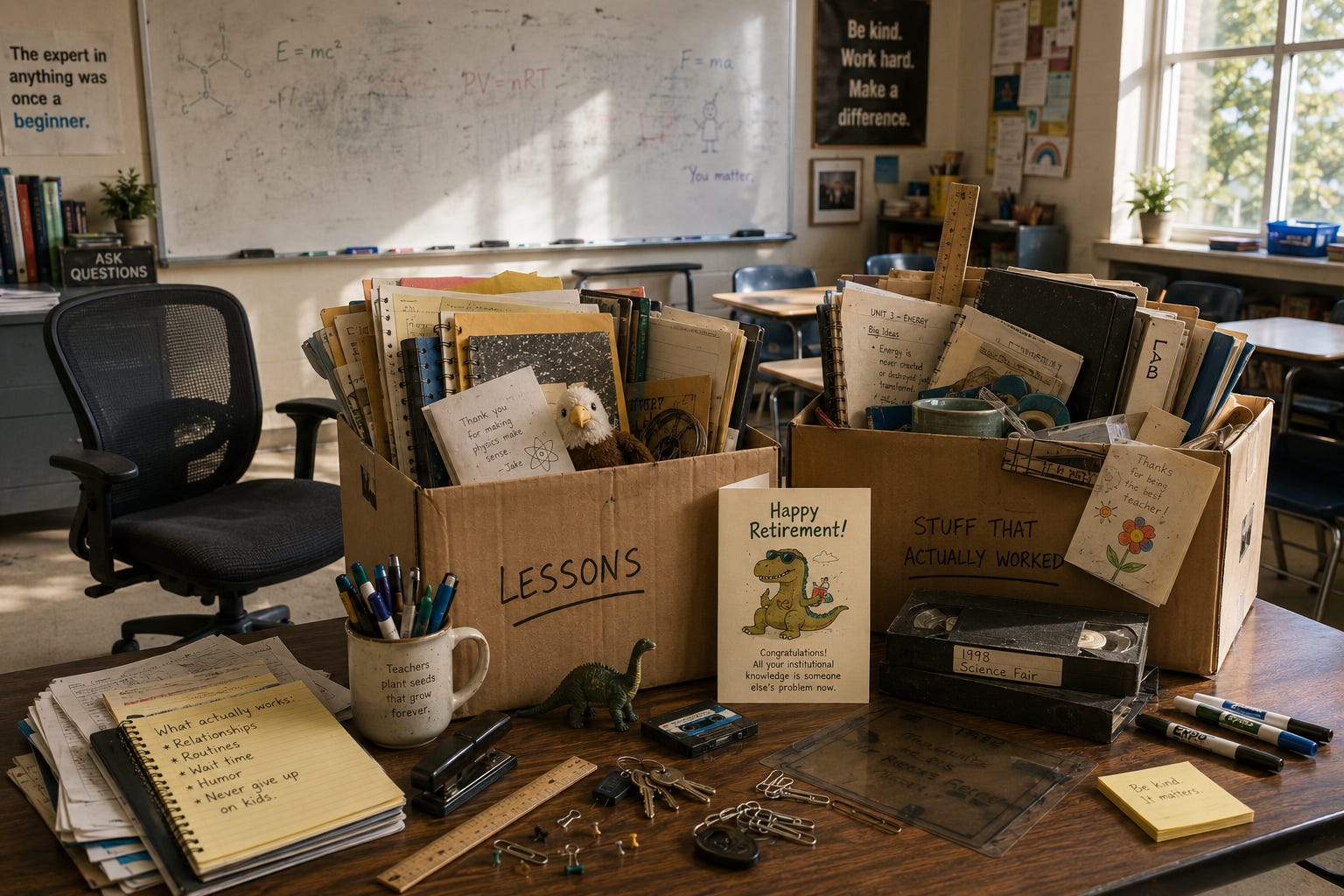
Someday, he’ll retire. Where does that expertise go? How much of it survives?
Hell, I watched a good friend retire last month after his 30-year run, and good God, he was a treasure trove of insight and knowledge, inspiring kids8, building relationships with students, keeping a department together, and challenging leadership when leadership needed challenging. He’d drop amazing teaching insights through his kind of lazy southern drawl, and…
All that’s gone.
I mean, my friend’s not dead, but everything that made him such a good teacher, down to his VCR...
is gone9.
Gonna miss him, but man - what these kids next year won’t get.
Why Aren’t We Fixing This?
Schools are stuffed with expertise. They run on hierarchies that can transmit information efficiently, but not knowledge. And every year, some of that expertise walks out the door.
None of this is new. So why don’t we fix it? Public education isn’t great at building things that work, but this? Expertise seems important.
But there are issues.
One: Expertise reveals problems.
A teacher develops a better lesson than the prescribed one. Another revises the pacing guide to better build the content and help students intuitively grasp it. A third develops a different teaching style that works 10 out of 10 times. That’s expertise.
But what does that say?
Improvements are needed in the lessons, the pacing guide, and the current teaching style. That’s uncomfortable if the organization is invested in the purchased lessons, the content specialists worked on the pacing guide for months, and 5E is how science instruction is expected to be taught in all rooms, amen.
Expertise often stands against the status quo. Organizations love innovation in the abstract. It's much harder when that innovation suggests the current way of doing things isn't the best way10.
Case in point, I don’t write “Essential Questions” on my board anymore. I think they’re stupid, and for the kids, they became furniture. I came up with something better, even though my leadership says they’re looking for that when11 they come into a room. Do I ride in, Quixote-like, and let leadership know that the way we’ve been told to do things might not be the best? Heck no. Not a hill worth dying on.
That makes it hidden expertise—knowledge that doesn’t spread because the cost of sharing it outweighs the benefit. Which means I may be part of the problem12.
Two: Expertise reveals that consistency =/= quality.
Man, that’s the nice way of saying it.
Everybody loves consistency. Leadership. Teachers. Students. Parents. Who doesn’t like to know that what happened yesterday will happen today as well? I once had a principal who literally said he should be able to walk from one biology classroom to another, and the second teacher should basically be finishing the sentence the teacher in the other room started. Yeah, that poor, confused soul is no longer a principal.
Anyway, consistency can be good. We've also lived through enough miracle cures, silver bullets, and recycled ideas with new names that skepticism is often the default response. And that’s fair. Needed, to an extent. Not every new idea deserves a parade.
But repeated skepticism can easily turn into institutional cynicism.
I’ve worked with far more people who will tell you exactly why something won’t work than those who are interested in figuring out how it might.
When skepticism leans towards cynicism, and that starts running the show, that’s gatekeeping.
I have very little patience for gatekeepers. For the life of me, I can’t understand how they can show up in education13. Aren’t we telling our kids every day to question assumptions, be curious, challenge me when I say something that sounds like bullshit, test ideas, and make mistakes and learn from them?
Why then, when we have meetings, does everyone become a risk-management specialist?
Our entire profession is built on learning, yet I’ve been in organizations that seem dead-set on protecting themselves from it. After a while, you start to wonder whether we're preserving best practices or just preserving practices. Whether we care about “producing excellence14” or just maintaining the status quo.
In business, “We’ve always done it this way” is usually the beginning of a problem. At least, it’s never the solution the speaker thinks it is15.
In education, it sometimes feels like a leadership competency.
Probably taught by Voldemort.
So How Do We Fix This?
The pieces are easy.
No one has to leave the classroom (unless they want to).
Expertise is already spreading through schools, but schools rarely notice it, support it, or reduce friction in its way.
The moments that shaped me as a teacher almost always came from other teachers. To this day, I still maintain that not a single word uttered by anyone in the hierarchy between the superintendent and me has changed how I teach my class.
All of my transformative moments came from other teachers when I walked into their room after school, a cyclone of frustration about a kid, a lesson, and an assessment that missed the mark. A word of advice before starting class. A resource that made me stop and think, “Well, that would’ve saved me a lot of time had I known that five years ago.”
Expertise flows in networks.
And our networks are sharing it all the time. We steal from each other constantly. We borrow ideas, adapt them, and solve problems together.
That’s teaching.
The best school I ever worked at wasn't the one with the highest EOC scores. It was the one where people talked to each other. Doors were open. Ideas moved around. Nobody acted like they owned a good idea just because they happened to think of it first.
So—how to make this work school-wide?
First, schools have to admit that expertise transfer is part of the job.
Then, the organization has to make it work.
The means of expertise flow cannot be seen as favors, as extras, as off-time things you can do if you want to. It has to be baked into the school’s design and the flow of the school calendar.
The musts — for expertise to spread in a school and larger district, you must have:
Open Classrooms: Colleagues can (and are expected to) observe each other whenever it is convenient for both the observee and the observer. Everyone can learn something from someone. If you put a form to this that one party or the other has to fill out, you’ve killed it. Now it’s just more performative compliance.
Protected Mentorship Time: Direct, person-to-person knowledge sharing. As a feature, not an add-in for when you have time, or as a reason to stay late. Information dumps, downloads, letting off steam, brainstorming. All here, with a colleague.
Also, an overall plan for the semester and year should be carefully designed to tie specific issues to seasons in which they arise. Not just “grades are due at the end of the quarter,” but “Hey - October will feel like the longest damn month ever, and it’s okay. We’re all feeling it.” Protected time.
Resource Libraries: Schools should have Wikis to store and share institutional knowledge. Full stop. This needs to happen. Digital libraries of assessments, lessons, notes, slide decks. Open and available. Oh, and if anyone from any IT is reading this, and getting all horny at the idea of a collection of generated resources that an AI Agent can crawl over and be trained to create all new resources for the district, kindly go fuck yourself.
Cross-school Visits: Again, no real explanation needed- just time and availability, during contract hours, not having to show up after the contract day is over. Exchange ideas.
Conference Support: In every other profession, professionals have professional organizations and professional conferences. These are huge concentrations of expertise. Schools and districts that don’t fund their teachers to attend and/or present at state and national conferences are cutting off their nose to spite their face. We should be cultivating experts.
None of this is revolutionary. Most teachers already know it.
I knew it too. I mean, I’m annoyed at how fucking simple it is.
I bet a lot of other teachers in my building and district know this as well. But that doesn’t mean we have it. Again, schools can say they celebrate innovation and teacher leaders, but when follow-up questions get asked: “How often do you allow teachers to work with peers? To share resources? Given them unstructured time for collaboration? Pay for them to attend conferences?”
The answers start to get a little “Um…” and “Uhh,” and things that have nothing to do with the question start to get mentioned. Maybe even…
jargon.
And two more things that have to be in the list of non-negotiables for expertise to spread:
Egos stay at the door, and everyone understands the importance of the job. If you don't want to share a resource because it's what makes your class special, are you saying you can't come up with another one? And why can’t other teachers and students benefit from it?
Accountability is intrinsic. The minute you put an admin in these places, sharing becomes performative, and everyone tries to please the non-expert in the room whose interest is not in learning from teachers but in ticking off boxes on a list. Trust us to do the right thing. We’re not just experts; we’re professionals.
Nothing above requires con$ultants or a strategic plan with a six-figure price tag. People tend to share what works and their expertise naturally.
The question is whether we actually want expertise to spread, and if we do, what we're willing to do about it. Saying it doesn’t help, action does.
When I run in the mornings, I’ve been looking at a lot of trees people have in their front yards, and I realized something. The best time to plant a tree isn’t after the old one with the thick16 trunk falls down.
It’s while the old one is still standing there doing tree stuff. And maybe it lasts way longer than you thought it would. Worst case, you end up with more big trees in your yard.
So yeah— someday, my Uncle Joe will retire, and someone will replace him. That’s the easy part. The harder part is what happens to the thirty-six-plus years of knowledge walking out the door with him?
I know how we answered that at my school when my friend retired this year. What happened to his knowledge? Nothing. It left with him.
If a business lost thirty+ years of institutional knowledge every time an employee retired, we’d call it a crisis.
In education, we call it June.
The classroom is where I do the work.
The Science Of is where I chase the questions.
If you’d like more stories about science, dinosaurs, asteroids, history, space, comics, and the strange connections hiding between them, come join me over there.
Or see myself as through my personal, warped funhouse mirror.
Every disruption to society should have its own remodel of public education to produce citizens who can live and work in it, but we missed the Information Age and the Connected Age, and whatever this age coming up should have its own model
If you replace every stick of wood and sail in the ship, do you still have the same ship when you’re done? That old one.
That’s my last sailing or boat reference. I think.
Led by consultants, or worse, district people who ran away from the classroom before the pandemic hit, and are thus as helpful as a one-toothed beaver in a petrified forest.
We’re not counting the rage-quitters here. While they may have important things to say about the organization as a whole, it wouldn’t really be considered “expertise” for the job.
If you’ve ever been to…really any football game ever, you’ve probably heard “Let’s Go Blue,” which Joe co-wrote while a student at the University of Michigan. There it was. My biggest claim to fame ever.
Including mine.
And what I’ll miss most is him seeing me in the hallway and starting up with the line from Inherit the Wind when Spencer Tracy starts with, “Brady, Brady, Brady…” My pal could do a decent Spencer Tracy impression as well.
Want a fun time? Ask your district leadership what the latest innovation in education that came from the district was. Do it - it’s fun. See also asking your leadership to name the last thing they were wrong about in education, the last thing they changed their mind about in education, and how their mind was changed. Good times.
Yeah, I know — same: if they come in. If they do ask, I make them a deal: I’ll put them back up if they can tell me under what larger initiative we adopted the practice of EQ’s. Spoilers: It was “Learning Focused Classrooms,” which in and of itself is a stupid name for an initiative. But it is by far the last dangling bit of Learning Focused that remains as any kind of practice, and it’s there for them — they see it, check the box on the iPad, move on to line two.
But just wait until my PD on AI use in the classroom.
Part 348 of my ongoing series of “Hey, we’re teachers. Shouldn’t we be better at x than we are?” Where x can be anything from trying new ideas to showing critical thinking skills ourselves.
By the way, any school motto, vision statement, or goal that includes the word “excellence” makes me want to vomit and tells me that whoever wrote it has nothing to do with students on any given day - or just copied it from a different school.
Oftentimes, it’s the start of passing around the poison to drink, rather than the Kool-Aid (I know, it’s a confusing metaphor, because the Kool-Aid was the poison, but go with me) and the company is overtaken by competitors who don’t give two shits about the status quo, only producing the product.
All teachers (except the folks who run a lot - more than me) get thicker as we get older, just in case you needed help with the metaphor.
This is a great article and every word of it is true. Been teaching 30 years, and the hardest part is that much of the reason for my success and expertise in the classroom is that I don’t follow stupid trends like essential questions and all that nonsense. I recently decided to start a Substack in the hopes of sharing some of my non-revolutionary methods (which often seem revolutionary or to some even counter productive) to the younger generation of teachers. If you and I don’t start, the consultants and “experts” who have never taught will always win and our knowledge will be lost forever. I know I’m being dramatic, but it’s partly true. What I do works. I know it does because my 7th graders are proof of it. It’s not brain surgery, but it is intentional and takes work. Thanks for your article. I love your straight forward style.
Banger article. This is my first time ever leaving a comment on substack, that's how much I liked it